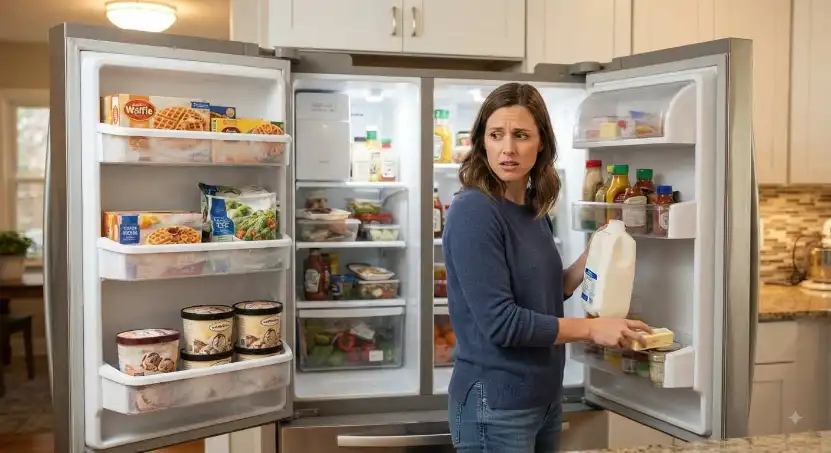
You open the fridge door expecting a blast of cold air and instead you get lukewarm milk and a soft stick of butter. Then you check the freezer next to it and the ice cream is still rock solid. It feels like a contradiction how can one half of the same appliance be working perfectly while the other half quietly gives up?
It’s actually one of the most common refrigerator complaints we see on refrigerator repair Oxnard CA service calls across Oxnard and Ventura County, and it almost never means the whole unit is dead. In the vast majority of side-by-side, top-freezer and bottom-freezer refrigerators, the freezer is the actual source of cold air for the fresh food compartment. When something interrupts the path that cold air travels between the two sections or when a sensor stops telling the system to send that air over you end up with exactly this scenario: a freezer that’s doing its job and a fridge that isn’t.
Below, we’ll walk through every realistic cause, how to tell them apart, what you can safely check yourself, and when it’s time to call in a technician instead of guessing.
How Your Refrigerator and Freezer Actually Share Cooling
Most modern refrigerators whether they’re top-freezer, bottom-freezer, or side-by-side models from Whirlpool, GE, Samsung, LG or Frigidaire use a single sealed cooling system for both compartments. The freezer houses the evaporator coils, where refrigerant absorbs heat and gets extremely cold. A small evaporator fan then pushes that cold air through a duct system into the refrigerator compartment.
That means your fridge doesn’t have its own independent cooling source in most designs. It’s essentially borrowing cold air from the freezer. So when the fridge stops cooling but the freezer stays cold, the compressor and sealed refrigerant system are usually still functioning the problem is almost always somewhere in that air-delivery chain between the two compartments or in the electronic components that control it.
Understanding this relationship is the key to diagnosing the issue correctly instead of assuming the whole appliance needs to be replaced.
Quick gut-check: If both the fridge and freezer are warm, you’re likely looking at a compressor, condenser or refrigerant problem. If only the fridge is warm and the freezer is still solidly cold the issue is almost always airflow, a sensor or a defrost-related component.
Top Reasons Your Fridge Isn’t Cooling While the Freezer Works Fine
1. Blocked or Frozen Air Vents Between the Compartments
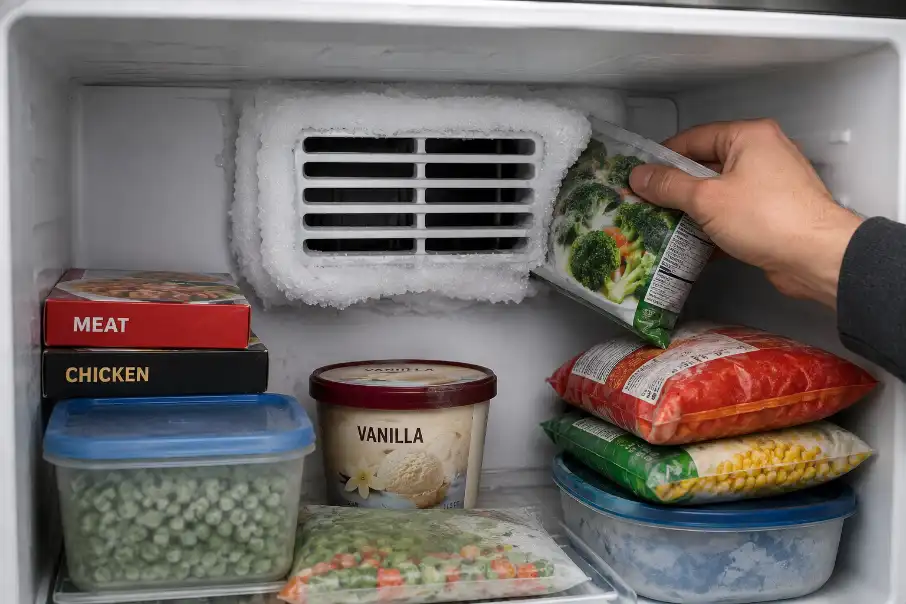
The single most common cause we find on service calls is a blocked air duct or vent between the freezer and refrigerator. Food packages pushed up against the back wall of the freezer, overstuffed shelves or a large frozen item positioned directly in front of the vent can all restrict airflow before it ever reaches the fridge side.
Frost buildup around this vent is another frequent culprit, especially in refrigerators where the defrost system isn’t clearing ice properly (more on that below).
What to check:
- Look inside the freezer for the air vent, usually located on the back wall or upper section.
- Make sure no food packages are pressed directly against it.
- Check for visible frost or ice buildup around the vent opening.
- Rearrange items so air can circulate freely rather than stacking food flat against the wall.
2. Failing Evaporator Fan Motor
The evaporator fan is the small motor responsible for physically pushing cold air from the freezer’s evaporator coils into the fridge compartment. If this fan is weak, unplugging intermittently or has failed outright the freezer can stay cold (since it’s right next to the coils) while the fridge receives little to no cold air at all.
A telltale sign is a buzzing, clicking or grinding noise coming from the back of the freezer or in some cases, total silence where you’d normally hear a faint hum. Some refrigerators pause this fan automatically when the door is open, so test with the door closed if possible.
What to check:
- Listen for the fan running when the freezer door is closed.
- Look for ice buildup around the fan blades, which can physically stop them from turning.
- If you’re comfortable and the unit is unplugged, spin the fan blades by hand to see if they move freely.
3. Defrost System Failure (Thermostat, Heater, or Timer)
Frost-free refrigerators use a small defrost heater on a timer or adaptive defrost control to periodically melt frost off the evaporator coils. If the defrost heater, defrost thermostat or control board fails, frost keeps accumulating on the coils instead of melting away on schedule.
Over time, that ice sheet essentially insulates the coils and blocks the evaporator fan, choking off airflow to the refrigerator while the freezer which sits closer to the coils still feels cold for a while longer.
What to check:
- Unplug the fridge remove food, and prop both doors open for 24–48 hours to fully defrost.
- If cooling returns to normal afterward, the defrost system is very likely the root cause and needs a proper repair not a repeat manual defrost every few weeks.
4. Faulty Thermistor or Temperature Sensor
The thermistor is a small sensor that monitors the refrigerator compartment’s internal temperature and reports it to the control board, which then decides when to run the compressor and evaporator fan. If the fridge-side thermistor fails or reads inaccurately, the control board may never “realize” the fridge is warm, so it won’t trigger the fan or damper to send cold air over even though the freezer’s own systems keep functioning normally.
This is a common issue on Frigidaire, Electrolux and several Whirlpool-built models.
5. Stuck or Broken Air Damper Control
Many refrigerators use a motorized damper (sometimes called an air diffuser or baffle) to regulate exactly how much cold air flows from the freezer into the fridge. If this damper gets stuck in the closed position due to a mechanical failure, frost jam, or a bad control board signal the fridge gets cut off from its cold air supply entirely, while the freezer continues operating as normal.
6. Overloaded or Poorly Organized Refrigerator
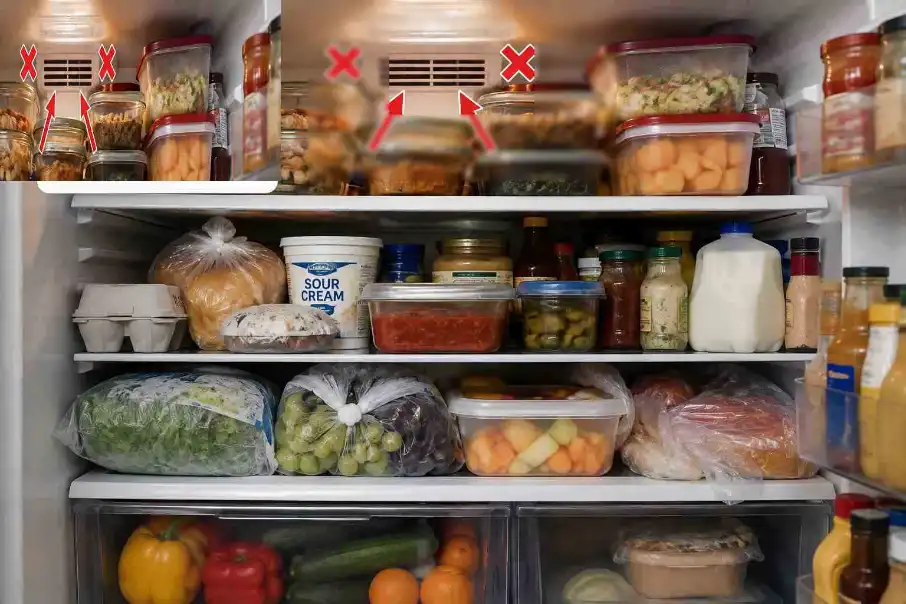
Sometimes the fix really is this simple. An overstuffed fridge restricts internal air circulation between shelves and large or tall items can block the vents where cold air enters from the freezer. A refrigerator packed with warm leftovers straight from the stove also forces the system to work harder than it’s designed to.
What to check:
- Remove excess items and check whether cooling improves within a few hours.
- Leave a small gap around vents and avoid lining the back wall solid with containers.
- Let hot food cool to room temperature before placing it inside.
7. Worn or Damaged Door Seals (Gaskets)
Cracked, torn, or loose door gaskets let warm kitchen air leak into the fridge continuously. This forces the system to run longer and in units where the fridge is already borrowing limited airflow from the freezer, a bad seal can be enough to keep the compartment from ever reaching a safe temperature.
Quick test: Close the door on a dollar bill or sheet of paper. If you can pull it out with little resistance, the seal likely needs replacing.
8. Dirty Condenser Coils
Condenser coils, usually located underneath or behind the unit, release the heat that’s been pulled out of the fridge and freezer. When they’re coated in dust, pet hair and debris, the whole system loses efficiency. This doesn’t always affect both compartments equally often the freezer, being the primary cooling zone, holds its temperature longer while the fridge falls behind first.
What to check:
- Unplug the refrigerator and pull it away from the wall.
- Vacuum the coils and the surrounding area thoroughly.
- Repeat this every six months, more often if you have pets.
9. Refrigerant Leak or Low Refrigerant Charge
This one is less common as a cause of “freezer cold, fridge warm” specifically, but it does happen, particularly with a partial leak. A slow leak can reduce the system’s overall cooling capacity to the point where it can only maintain the colder freezer compartment and can no longer push enough cooling into the fridge. Oily residue near refrigerant lines or the compressor is often a visual clue.
Refrigerant work requires EPA-certified handling and specialized equipment, so this is not a do-it-yourself repair.
10. Control Board or Temperature Setting Issues
On some models, a glitching main control board can send incorrect signals to the fan or damper without any obvious hardware failure elsewhere. Before assuming a board issue, it’s worth double-checking that the refrigerator’s temperature dial or digital setting hasn’t accidentally been bumped to a warmer setting, especially in households with kids or if the unit was recently cleaned.
Quick Comparison: Likely Cause vs. What You’ll Notice
| Cause | Common Signs | DIY-Friendly? |
|---|---|---|
| Blocked vent / overloaded fridge | Uneven cooling, warm spots near back wall | Yes |
| Evaporator fan failure | Buzzing/clicking noise, or silence from freezer back panel | Partial just inspection only |
| Defrost system failure | Heavy frost on rear freezer wall, fridge warms gradually | No that needs repair |
| Faulty thermistor | Fridge runs constantly or never cycles on | No |
| Stuck air damper | Freezer cold, almost no airflow felt at fridge vent | No |
| Worn door gasket | Visible cracks, weak seal, condensation on door frame | Yes (seal replacement) |
| Dirty condenser coils | Fridge runs longer than usual, warm exterior sides | Yes |
| Refrigerant leak | Oily residue, weak or inconsistent cooling over time | No professional only |
Step-by-Step: What to Check Before Calling a Technician
- Clear the vents. Rearrange freezer items away from the back wall and vent openings.
- Check the temperature settings. Confirm the fridge is set between 35–38°F and the freezer near 0°F.
- Inspect for frost buildup. Heavy ice on the freezer’s rear wall points to a defrost system problem.
- Test the door seals. Run the dollar-bill test on both doors.
- Clean the condenser coils. Unplug the unit and vacuum thoroughly.
- Do a full manual defrost. Unplug for 24–48 hours with doors open if you suspect ice buildup, then monitor whether cooling returns.
- Listen for the evaporator fan. No sound at all, or a grinding noise, suggests fan failure.
If you’ve worked through these steps and the fridge is still warm while the freezer works fine, the issue is very likely a failed component fan motor, defrost heater, thermistor damper or control board that requires diagnostic testing with a multimeter and, in most cases, a replacement part.
When It’s Worth Calling a Professional
A few situations are worth skipping the DIY troubleshooting altogether and going straight to a technician:
- You smell burning or notice scorch marks near the control board.
- The compressor runs constantly without ever shutting off.
- You see oily residue anywhere along the refrigerant lines.
- The unit is under manufacturer warranty (opening it yourself can void coverage).
- You’ve completed a full defrost and cleaned the coils, and the fridge still won’t cool.
Refrigerator repairs involving sealed refrigerant systems, control boards or defrost assemblies typically run anywhere from $150 to $450 depending on the part and labor involved while a full compressor replacement can run higher. If your refrigerator is more than 10–12 years old and facing a major component failure, it’s worth weighing that repair cost against the price of a new energy-efficient unit.
Preventing This From Happening Again
A little routine maintenance goes a long way toward avoiding a repeat of this exact problem:
- Clean condenser coils twice a year.
- Avoid overloading either compartment and leave breathing room near vents.
- Replace door gaskets at the first sign of cracking rather than waiting for them to fail completely.
- Let hot leftovers cool before refrigerating them.
- Keep the freezer at least half full for better temperature stability, but never packed solid against the vents.
Small habits like these reduce strain on the evaporator fan, defrost system and compressor which are the components most likely to fail and trigger this exact “cold freezer, warm fridge” symptom down the road.
Frequently Asked Questions
Is it safe to keep using my fridge if only the freezer is cooling?
Short term, yes, but food safety becomes a concern quickly. The refrigerator compartment needs to stay at or below 40°F to keep perishables safe. If it’s warmer than that for more than two hours it’s best to move essentials to a cooler or the freezer temporarily and address the repair promptly.
Can I fix a bad evaporator fan or thermistor myself?
Inspection and basic testing (listening, checking for frost, visual inspection) are safe for most homeowners. Actual replacement involves disassembling interior panels and working near electrical components, so most people are better served having a technician handle the repair especially on newer digital-control models.
Why does my freezer stay cold but my fridge takes hours to warm up instead of right away?
This gradual pattern is typical of a slow defrost failure or a partially blocked vent residual cold air keeps circulating for a while before the imbalance becomes noticeable. A sudden complete loss of fridge cooling more often points to a fan or thermistor failure.
Does this happen more with certain brands?
Every brand can experience this issue since nearly all standard refrigerators share the same freezer-to-fridge airflow design. That said defrost thermostat and adaptive defrost control failures are especially common complaints on Whirlpool-built and Frigidaire/Electrolux-platform refrigerators after several years of use.
If you’re in Oxnard, Camarillo, Ventura, or the surrounding areas and you’ve worked through these checks without any luck our refrigerator repair Oxnard CA technicians can diagnose the exact component causing the problem and get it fixed the same day in most cases. We also handle freezer repair for units with the opposite issue and if the appliance turns out to be beyond a cost-effective repair our team can walk you through your options.
While you’re getting things back in working order, it’s also worth checking a couple of related appliances that share similar failure patterns our guide on dryer troubleshooting covers another “one part works, one doesn’t” scenario that’s just as common. And if this refrigerator is getting close to the 10-year mark, our appliance repair vs. replacement page breaks down how to think through that decision. For same-day help, you can always reach our Oxnard appliance repair team directly.
For general food safety guidance on how long refrigerated items stay safe once temperatures rise the USDA FoodSafety.gov cold storage guidelines are a solid reference to keep on hand.